
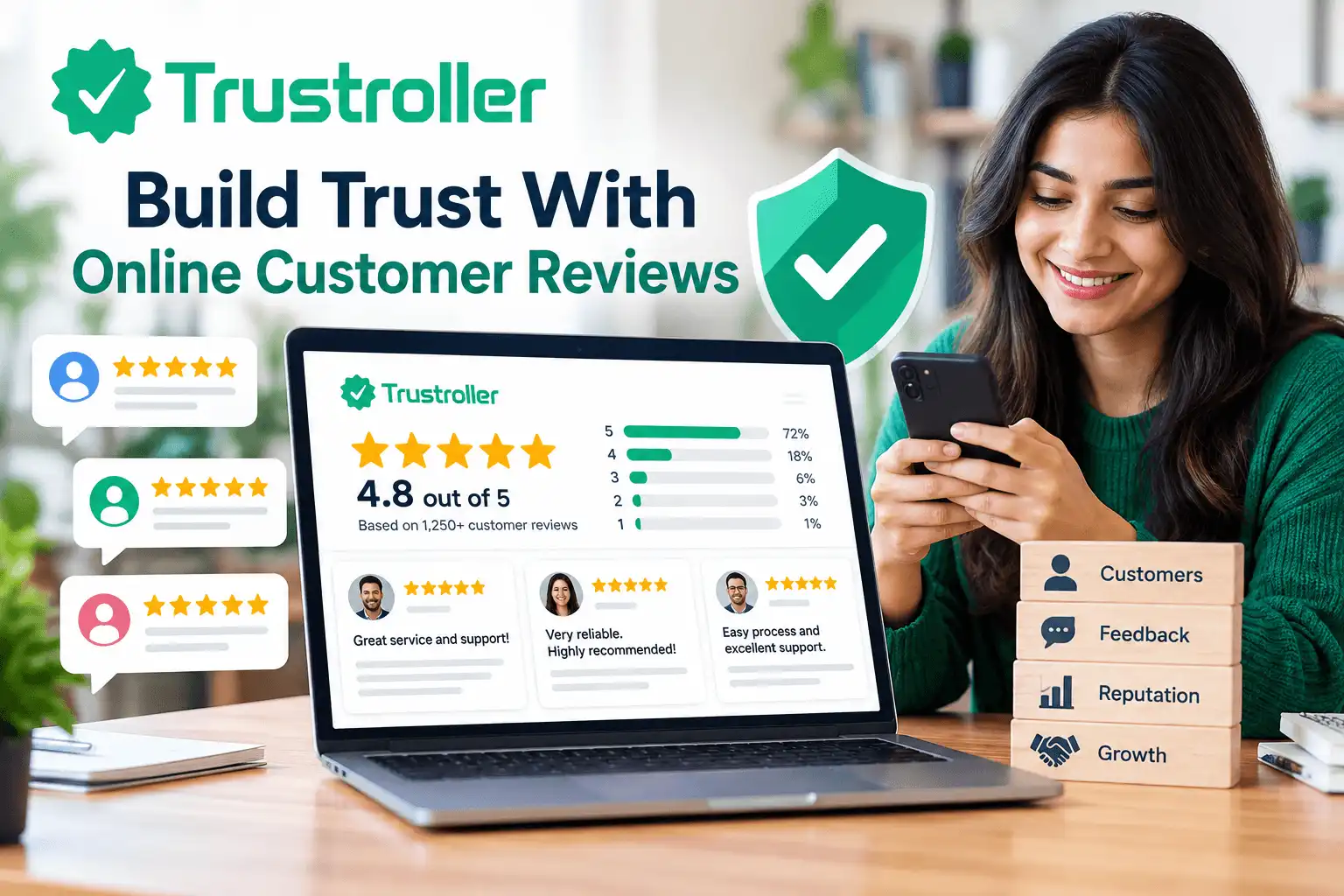
Online customer reviews have become one of the strongest trust signals for modern buyers because people often want proof from other customers before they spend money, book a service, create an account, or contact a business. A company can publish polished marketing content, professional product photos, and confident sales messages, but many customers still want to know what real users experienced after making a purchase. This is why learning how to build trust with customer reviews is so important for small businesses, online stores, service providers, SaaS companies, local brands, and growing digital businesses. Reviews can reduce uncertainty by helping potential customers understand what others liked, what they expected, and how the company handled the overall experience.
They also create a layer of social proof that is difficult to achieve through advertising alone. However, reviews only build trust when they are collected and presented honestly. Fake reviews, copied testimonials, misleading ratings, or pressure-based review requests can damage credibility instead of improving it. A trustworthy review strategy begins with transparency. Customers should be free to share genuine opinions, whether those opinions are positive, neutral, or critical. Businesses should also avoid editing reviews in a way that changes their meaning. The goal is not to create the appearance of perfection. The goal is to show that real customers have interacted with the business and that the company pays attention to their feedback. For beginner business owners, this can feel challenging because they may worry about receiving negative comments.
In reality, a profile with only perfect ratings can sometimes appear less believable than one that includes a healthy mix of feedback and thoughtful responses. What matters most is how consistently the business provides good service and how professionally it responds when something goes wrong. A useful review system also helps the business learn. Repeated complaints may reveal a confusing checkout process, slow communication, unclear pricing, delivery delays, or missing product information. Positive comments can reveal which parts of the customer experience are working well and should be protected. In this way, reviews are not only marketing assets; they are also a source of customer research. TrustRoller can be part of this process by giving businesses a dedicated place to collect and display customer feedback while helping users evaluate experiences shared by others.
The value comes from using reviews responsibly, not simply from collecting a large number of them. When a business makes review collection easy, responds respectfully, verifies information where possible, and uses feedback to improve service, customer reviews become much more than ratings on a page. They become evidence of accountability, communication, and real customer experience. That is the foundation of a sustainable reputation, and it is the starting point for any business that wants to build trust with customer reviews in a genuine, long-term way. For a new business, this approach is especially important because potential customers may know very little about the brand. A clear review history can answer questions that marketing pages cannot answer on their own. It can show whether customers received what they expected, whether support was available when needed, and whether the business responded appropriately to problems.
Even a small number of thoughtful reviews can be useful when they are genuine, recent, and relevant. The key is to let trust grow from actual customer experiences rather than trying to manufacture a perfect image. That distinction protects the business from short-term tactics that may create long-term reputation problems.
Why Customer Reviews Matter for Building Trust
Trust matters because online buyers usually face more uncertainty than customers shopping in person. They may not be able to inspect a product, meet the business owner, visit an office, or talk face-to-face with a support team before paying. Reviews help reduce that uncertainty by giving potential customers access to experiences from people who have already interacted with the company. When several customers describe similar positive experiences, such as clear communication, reliable delivery, accurate product descriptions, helpful support, or easy problem resolution, new visitors gain more confidence that the business is likely to provide a consistent experience.
This is one reason businesses that want to build trust with customer reviews should focus on quality, relevance, and authenticity rather than simply chasing a high review count. A smaller collection of detailed, believable reviews can be more useful than hundreds of vague comments. Detailed reviews help shoppers understand context. For example, a customer may explain why they chose a service, how quickly the business responded, what problem was solved, and whether expectations were met. That information helps another buyer compare the service with their own needs. Reviews can also strengthen a brand’s reputation over time because they create a public record of customer experience. When a business receives praise, the review confirms what the company is doing well. When it receives criticism, the response becomes an opportunity to show professionalism.
A calm reply that acknowledges the issue, explains what can be done next, and invites the customer to continue the conversation through the proper support channel can demonstrate accountability to everyone reading the review. The response is important because future customers are often evaluating the business, not only the complaint. Reviews can also improve internal decision-making. If several customers mention that instructions are unclear, a business can update its help pages. If customers repeatedly praise fast support, the company knows that response time is an important strength. If people misunderstand a feature or price, the business can improve its product page. This feedback loop can improve the overall customer journey and make future reviews more positive naturally. There is also an SEO and discoverability benefit when reviews are published on relevant platforms or business profiles, because fresh customer-generated content can provide useful context around a brand, product, or service. However, businesses should not make exaggerated promises about rankings or visibility because review impact varies by platform, industry, competition, and search engine behavior.
The safest approach is to see reviews as one part of a wider reputation strategy that also includes good service, accurate information, strong support, clear policies, and consistent communication. Reviews matter most when they reflect the real experience behind the business. If a company actively listens to customers, fixes recurring problems, and makes review collection a normal part of the post-purchase journey, it can gradually build a stronger reputation. The result is not instant trust, but a more credible online presence where potential buyers have better information, existing customers feel heard, and the business has a practical way to prove that it values customer experience.
A visible pattern of responsible responses can also show that the company does not disappear after a sale. For service businesses, this is especially valuable because buyers often judge reliability, communication, and follow-up as much as the final product. Reviews can therefore provide reassurance before purchase while also showing how the business treats customers after payment.
Step-by-Step Guide to Build Trust With Customer Reviews
A practical step-by-step review strategy starts with the customer experience itself because no review platform can replace good service.
Step 1 is to make sure the product or service delivers what the business promises. Before asking anyone for feedback, check whether product descriptions, pricing, delivery expectations, refund terms, support channels, and service limitations are clear.
Step 2 is to choose the right moment to request a review. The best time is usually after the customer has had enough time to use the product, receive the service, complete a transaction, or resolve a support issue. Asking too early can lead to weak feedback because the customer has not experienced enough to form an opinion.
Step 3 is to make the review process simple. Provide a clear review link or direct customers to your business profile on a trusted review platform such as TrustRoller. Avoid forcing users through unnecessary forms or complicated registration steps if they are not required.
Step 4 is to use neutral language when asking for feedback. Instead of saying, “Please give us five stars,” ask the customer to share an honest review about their experience. This supports more authentic feedback and helps the business build trust with customer reviews without manipulating the process.
Step 5 is to send review requests consistently, not only to customers you believe are happy. Selective review solicitation can create a misleading impression and may also conflict with the rules of some review platforms. A fair system invites feedback from a broad range of real customers.
Step 6 is to respond to reviews professionally. Thank customers for positive comments, answer questions when appropriate, and handle negative reviews with care. Avoid arguments, personal attacks, or revealing private customer information. If the issue requires account details, order numbers, payment records, or personal data, invite the customer to contact support privately.
Step 7 is to monitor patterns in feedback. Create a simple monthly process for reviewing common complaints, common praise, repeated feature requests, and service delays.
Step 8 is to turn useful feedback into business improvements. If customers repeatedly mention a confusing policy, rewrite it. If users praise a certain feature, make sure your marketing explains that feature clearly without exaggeration.
Step 9 is to display reviews where they help customers make decisions. Depending on the business, this may include a review profile page, product page, service page, testimonial section, or social proof area. Always keep the original meaning intact and clearly identify customer feedback as customer feedback.
Step 10 is to keep the process ongoing. Trust is built through consistency, so one short review campaign is less valuable than a steady system that collects honest feedback over time. Businesses can also create internal guidelines for who monitors reviews, how quickly responses should be posted, and when an issue should be escalated to customer support.
A beginner-friendly workflow can be very simple: complete the service, wait until the customer has had time to evaluate it, send a polite review request, monitor the response, reply professionally, and record any useful improvement ideas. Repeating that process after genuine customer interactions helps create a review profile that grows naturally. The most important principle is that reviews should reflect reality. A business that focuses on service quality first and uses reviews as an honest record of customer experience is much more likely to create sustainable trust than one that focuses only on ratings.
Common Mistakes to Avoid When Using Customer Reviews
Several common mistakes can weaken a review strategy even when a business has good intentions. The first mistake is buying or creating fake reviews. Artificial feedback may appear to improve ratings in the short term, but it can damage customer trust and may violate the rules of review platforms, search engines, marketplaces, or advertising systems. A second mistake is asking friends, employees, contractors, or people who did not actually use the product to post reviews as if they were customers. A review should represent a genuine experience and any material relationship should be disclosed when relevant. A third mistake is offering rewards only for positive reviews. Businesses may sometimes use incentives for feedback where platform rules allow it, but the incentive should not depend on the review being positive, and the relationship should be clearly disclosed when required.
A safer approach is to request honest feedback without tying a benefit to a particular rating. Another mistake is trying to remove every negative review. Not all negative feedback is unfair, and some criticism can help a company identify real problems. If a review violates platform rules, contains abuse, spam, or clearly unrelated content, the business can use the platform’s reporting tools. But genuine criticism should usually be answered professionally rather than hidden. Another mistake is responding emotionally. When a business owner feels personally attacked, it can be tempting to argue publicly. That often makes the situation worse. A better response focuses on the issue, acknowledges the customer’s experience, avoids blaming language, and offers a practical next step.
Businesses should also avoid posting private information such as phone numbers, payment data, account details, home addresses, or internal support records in public replies. Another common problem is using copied review text across multiple pages or presenting edited customer statements without context. If a testimonial has been shortened, the meaning should remain accurate. Businesses should not rewrite a complaint into praise or use a quote in a way that misrepresents the customer’s opinion. A further mistake is collecting reviews but never using the feedback internally. If customers repeatedly report the same problem and the business does nothing, the review program becomes a public record of unresolved issues. Companies that want to build trust with customer reviews should treat repeated feedback as an operational signal. Another mistake is sending too many review requests. Repeated emails, messages, or pop-ups can annoy customers and create the impression that the company cares more about ratings than service. One polite request and, where appropriate, one reasonable reminder is often enough.
Finally, many businesses make the mistake of expecting reviews to fix a weak customer experience. Reviews are not a shortcut. If delivery is unreliable, support is slow, product information is inaccurate, or refunds are difficult, better review messaging will not solve the underlying problem. The long-term solution is to improve the experience and let genuine customer feedback reflect those improvements. A strong review strategy is built on ethics, consistency, customer privacy, and clear communication. By avoiding manipulation, respecting platform policies, responding calmly, and learning from criticism, a business can create a review presence that looks credible because it is credible. That is far more valuable than trying to create a perfect rating that customers may not believe. Businesses should also avoid identical scripted replies to every customer. A short response that addresses the main point usually feels more attentive and credible than a generic message repeated under every review.
Customer Review Trust Checklist
A simple review checklist can help beginner businesses turn good intentions into a repeatable system. Start with the customer experience: make sure your product description, pricing, delivery timeline, service scope, refund information, support contact, and any important limitations are easy to understand before the customer pays. Next, decide when a review request should be sent. For a physical product, that may be after delivery and enough time for basic use. For a service, it may be after the work is completed. For software, the right timing may be after onboarding or after the user has successfully used an important feature. Then prepare a short, neutral request that asks for honest feedback and includes a direct link to the review page. Keep the wording simple.
Avoid asking only for positive ratings or suggesting what the customer should write. Make sure your team understands the same rule so that staff members do not accidentally pressure customers. Add review monitoring to a weekly or monthly routine. Check new reviews, identify questions, and respond where a response is useful. Positive reviews can receive a short thank-you, while critical reviews may need a more careful reply and an invitation to continue through support. Always protect customer privacy. Never ask the customer to publish sensitive order details or personal information publicly, and do not reveal that information in your own response. Add a feedback log for internal use. This can be as simple as a spreadsheet with categories such as delivery, product quality, support, billing, usability, communication, and feature requests. Review the most common themes each month and choose one or two realistic improvements.
Track whether the same complaints continue after changes are made. Another checklist item is transparency. If you display selected testimonials on your website, keep the wording accurate and do not imply that a selected quote represents every customer. If a review came from a specific platform, identify the source where appropriate. If there is an incentive or material relationship, follow the disclosure requirements of the platform and applicable rules. Businesses using TrustRoller or another review platform should also read the platform’s current guidelines so they understand what is allowed. Another item is consistency. Review requests should be sent through a defined process instead of only when someone expects a positive answer. That helps create a more balanced and believable profile.
Add response standards as well. Decide who is responsible for reviews, how quickly the team should respond, when a complaint should be escalated, and when no public response is necessary. Finally, review the review process itself. Ask whether requests are being sent at the right time, whether customers can submit feedback easily, whether responses sound human, and whether feedback is leading to real improvements. This checklist helps a business build trust with customer reviews in a practical way because every item connects back to a real customer interaction.
The goal is not to collect the maximum number of reviews. The goal is to create a reliable cycle: provide a clear experience, invite honest feedback, listen carefully, respond professionally, improve the business, and repeat. When that cycle becomes part of everyday operations, reviews can support reputation, customer confidence, and business learning at the same time. Check that your review links work properly on mobile devices and lead customers to the correct profile. Also review your request wording regularly so it remains friendly, neutral, easy to understand, and free from pressure to choose a particular rating.
Frequently Asked Questions About Customer Reviews
Frequently asked questions can help businesses understand how review trust works in real situations.
Q: How many reviews does a business need before customers start trusting it?
There is no universal number because trust depends on the industry, price, risk, review quality, recency, and the customer’s own expectations. A small local business may benefit from a modest number of detailed recent reviews, while a high-volume online platform may naturally have far more. Focus on steady authentic growth instead of chasing a target number.
Q: Are negative reviews always bad for a business?
No. A reasonable amount of criticism can make a profile look more realistic, and professional responses can show that the business takes problems seriously. What matters is whether complaints reveal repeated unresolved issues.
Q: Should a business reply to every review?
Not always, but it is usually helpful to respond to important feedback, questions, detailed praise, and complaints. Responses should add value instead of becoming repetitive.
Q: Can I ask customers to leave a five-star review?
It is better to ask for an honest review without telling the customer what rating to give. Neutral requests support authentic feedback and reduce the risk of misleading review practices.
Q: What should I do if I receive a false or abusive review?
First, document the issue and use the review platform’s reporting or dispute process if the content appears to violate its rules. Avoid responding with personal attacks. If you do reply publicly, keep the response factual and professional.
Q: Can I copy customer reviews from another platform to my website?
You should respect the platform’s terms, customer rights, and any applicable copyright or permission requirements. If you quote a review, keep it accurate and do not change its meaning.
Q: How often should I request reviews?
A business can request feedback after appropriate customer interactions rather than sending mass requests at random. The right timing depends on the product or service, but the customer should have enough experience to give meaningful feedback.
Q: What makes a review trustworthy?
Useful reviews are usually specific, relevant, consistent with the customer experience, and free from obvious manipulation. A profile also becomes more credible when feedback is recent and includes a natural range of opinions.
Q: Can reviews improve customer service?
Yes. Reviews can reveal recurring issues, confusing processes, weak communication, and popular strengths. Businesses can use those patterns to improve operations.
Q: How do online ratings affect customer trust and your business reputation?
Online ratings can strongly influence how potential customers view your business before they buy. Consistent, genuine reviews can improve credibility, while poor or unmanaged feedback may reduce confidence. Learn more in our guide: How Online Ratings Affect Your Business Reputation.
Q: How can TrustRoller help?
TrustRoller can provide a place where businesses and customers connect through online reviews, helping companies build a visible record of customer feedback. Businesses should still follow ethical review practices and use customer comments to improve service.
Q: What is the best way to build trust with customer reviews over the long term?
Provide a good experience, ask customers for honest feedback, respond professionally, protect privacy, follow platform rules, and make real changes when reviews reveal recurring problems. Those actions are more important than trying to maintain a perfect score. Trust grows when customers can see that the business is consistent, transparent, and willing to listen.
Q: Should older reviews be deleted?
Usually, genuine older reviews can remain unless they violate platform rules. What matters is continuing to earn recent feedback so customers can understand the current experience.
Q: Can I request reviews by email or messaging apps?
Yes, when appropriate and permitted, as long as the request relates to a real customer interaction and follows applicable communication and platform rules.
Conclusion and CTA: Start Building Customer Trust Today
Building a trusted online reputation is a long-term process, but the daily actions behind it are simple: deliver what you promise, make communication clear, ask real customers for honest feedback, respond with respect, and use what you learn to improve. Businesses that follow these principles can build trust with customer reviews without relying on fake praise, hidden incentives, or manipulative tactics. That makes the review profile more useful for both sides. Potential customers gain practical information that helps them decide whether a product or service fits their needs, while businesses gain direct insight into what customers value and where the experience can be improved.
The most effective next step is to create a repeatable review workflow. Decide when customers will receive a review request, write one neutral message that your team can use consistently, choose the review platform where feedback will be collected, and assign someone to monitor new reviews. Then create a simple rule for responses: thank customers for useful feedback, address complaints calmly, move private account issues into secure support channels, and never argue publicly. Once a month, review the feedback as a team or as a business owner. Look for repeated themes and choose specific improvements. If several customers say the checkout process is confusing, simplify it. If people repeatedly praise fast support, protect that service standard as the company grows. If buyers misunderstand delivery times, make the information more visible before purchase.
This is how customer reviews become part of business development instead of being treated only as marketing content. TrustRoller can support that process by giving businesses a dedicated environment for online reviews and customer feedback. A business can use its review presence to show that it listens, responds, and values genuine customer experience. At the same time, customers should be encouraged to share fair and honest opinions so that the review ecosystem remains useful. The final goal is not to create a flawless image. Customers know that mistakes happen. What builds confidence is seeing a business behave responsibly when things go well and when problems occur. A company that communicates clearly, solves issues when possible, protects customer data, and learns from feedback gives buyers more reasons to feel comfortable.
If your business has not started collecting reviews yet, begin with recent real customers and a simple, transparent request. If you already have reviews, audit them for quality, recency, unanswered complaints, repeated problems, and opportunities to improve the customer journey. Keep the process consistent and let your reputation grow from genuine customer experiences. Visit TrustRoller to explore how online reviews can support stronger customer relationships and a more transparent business reputation. Use reviews as proof of accountability, not as a shortcut to popularity. When customer experience, honest feedback, and continuous improvement work together, reviews become one of the most practical tools for earning trust online and strengthening a business over time. You can start small today.
Review your most recent completed customer interactions, identify where a polite feedback request naturally fits, and make sure your support team knows how to handle both praise and criticism. Then measure success by more than the average star rating. Look at whether reviews are becoming more detailed, whether customers mention improved service, whether recurring complaints are decreasing, and whether your team is learning from the feedback. These indicators show whether the review program is actually strengthening the customer experience rather than simply increasing the number of ratings.
Comments (0)